

A sell-sheet redesign clarifies the facts a business supplies. It can make products easier to compare, give commercial terms a useful order, and turn a vague call to action into a specific next step. Opening minimums, case packs, and usable product photography have to arrive as confirmed inputs.
That boundary matters because a crowded document and an incomplete document are different problems. A crowded source may contain everything a buyer needs, hidden inside weak hierarchy. An incomplete source asks design to disguise decisions the business has not made yet.
Before a wholesale sell sheet goes into layout, it needs a source-readiness check.
Separate hierarchy problems from missing inputs
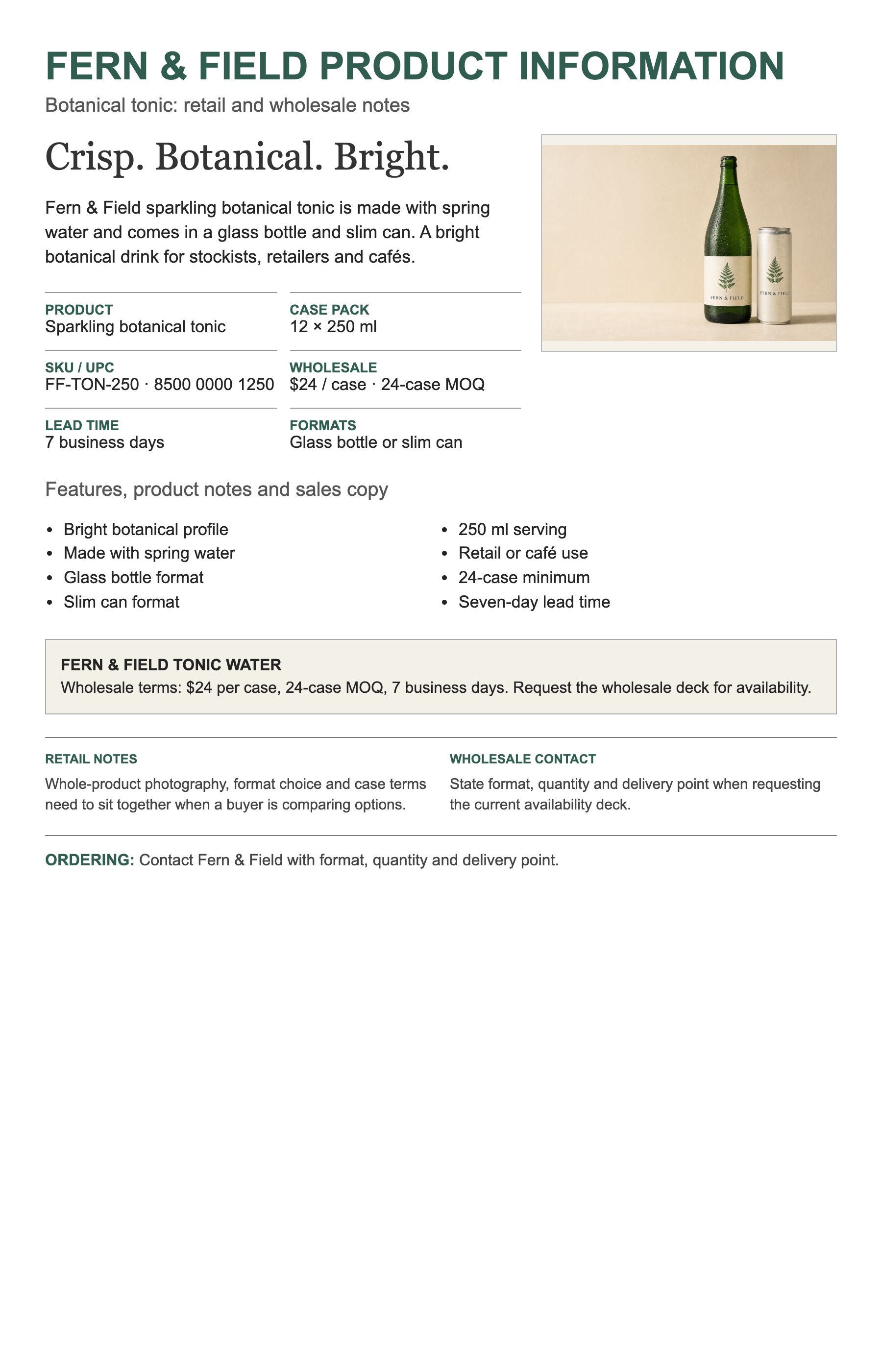
Consider Fern & Field, a fictional botanical tonic brand created for this exercise. Its source sheet is not elegant. The product story, case pack, SKU, wholesale price, minimum order quantity, lead time, packaging format, retail notes, and contact path are packed into one dense page.
The page is hard to scan, but it is ready to redesign because the commercial facts exist.
That distinction prevents a common handoff failure. If the designer receives only a product name, two photos, and a short brand story, the first round may look more polished while the buying path stays unresolved. The missing inputs do not disappear. They return as placeholders, follow-up questions, or assumptions that have to be corrected later.
A source-readiness check asks a narrower question than “Do we have content?” It asks whether the material is specific enough to build a truthful wholesale decision surface.
Start with the product identity
The first group of inputs tells the buyer what is being offered.
For each product or variant, the source should identify the product name, variant name, size or count, SKU or UPC when relevant, packaging format, and a short factual description. If the range has three flavors, the document should make clear what changes between them and what stays constant.
This is not the place to force a final headline. Rough source language can go into layout once contradictions are resolved.
If one spreadsheet calls the product a 250-milliliter bottle and the packaging file calls it 275 milliliters, layout should stop until the source of truth is confirmed. Picking the value that fits the layout puts an unverified number in front of a buyer.
A ready source pack names the authoritative file or owner for each product fact. That can be a current inventory export, a packaging specification, or a simple approved product table. The format matters less than the certainty.
Separate commercial terms from product features
Product features describe the item. Commercial terms describe how the buyer can order it.
At minimum, the source pack should answer the terms that shape a first wholesale decision:
- wholesale unit or case price;
- case pack;
- opening minimum and reorder minimum;
- suggested retail price, if the brand uses one;
- typical lead time;
- shipping region or important freight boundary;
- payment terms, if they belong on the sheet;
- the exact path for requesting a line sheet, order form, or wholesale conversation.
Not every detail belongs in the final one-page document. The designer may move some information into a separate line sheet or order form. But the information has to exist before that editorial choice can be made honestly.
“Contact us for details” is sometimes a deliberate sales boundary. It should not be the default substitute for missing terms. If buyers are expected to assess basic fit before contacting the brand, hiding every commercial fact makes them start a conversation just to discover whether an order is possible.
Trace each proof point to its source
A sell sheet may include certifications, materials, manufacturing details, retail partners, awards, press mentions, or sales claims. Each proof point needs a source and a permission boundary.
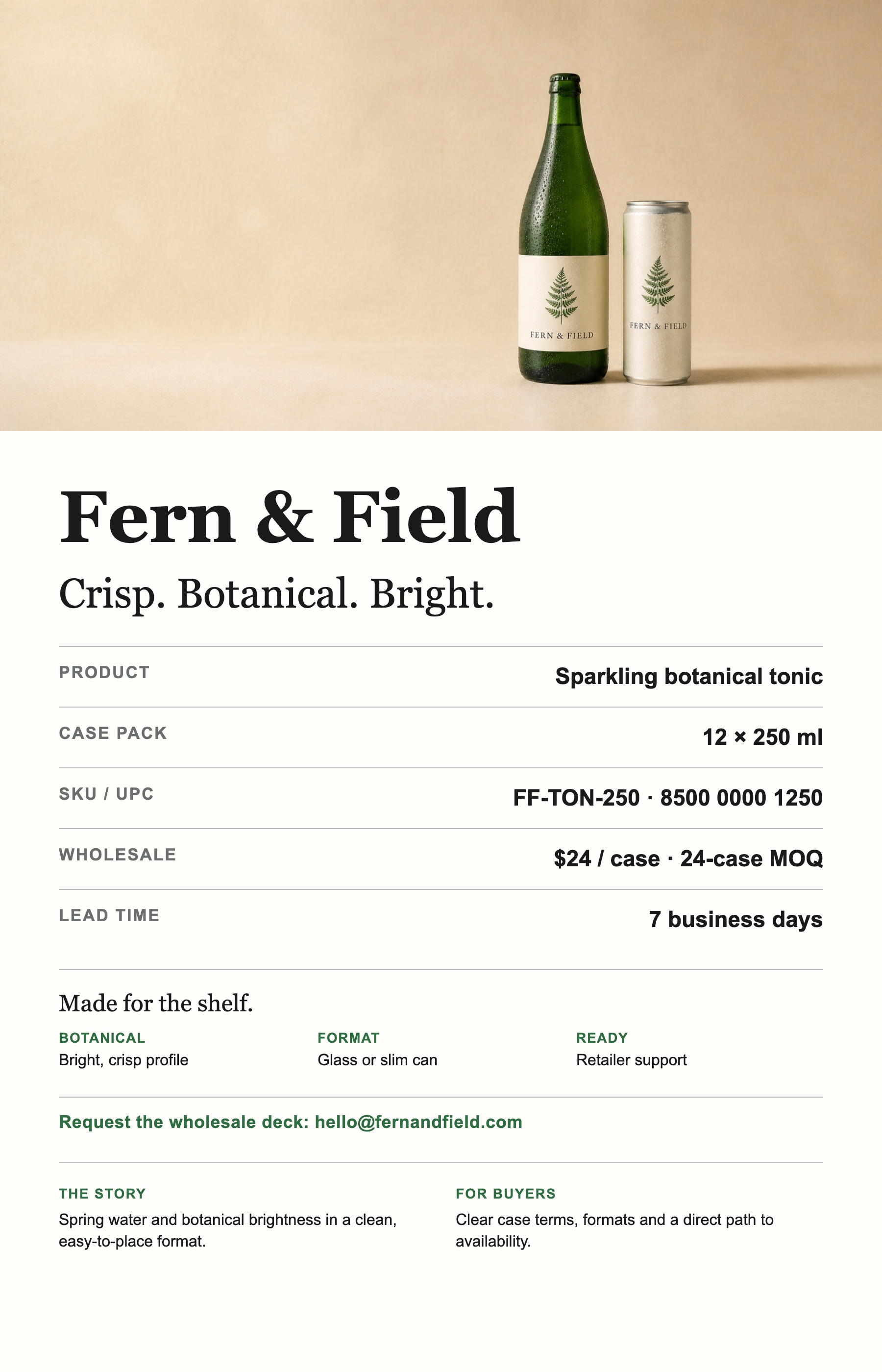
For a fictional concept like Fern & Field, there are no real retailers, certifications, testimonials, or performance results to borrow. The artifact can demonstrate hierarchy and judgment, but it cannot pretend to demonstrate market traction.
For a real brand, source readiness means being able to trace each proof point. A certification needs its current approved wording. A retailer logo needs permission. An award needs the correct title and year. A performance statement needs evidence strong enough for the claim being made.
If the support is missing, remove the proof point or mark it as unresolved before layout. A visual badge does not make uncertain evidence safer.
Check whether the assets can survive the page
A usable image has enough resolution for the page, current packaging, appropriate usage rights, and a composition that survives the intended placement.
The source pack should include the highest-resolution product photography available, ideally with clear usage rights and consistent versions of the current packaging. It should identify which image is the hero, which variants must appear, and whether any old label or discontinued product needs to be excluded.
Useful checks include:
- Is the product sharp enough at the intended print or screen size?
- Is the packaging current?
- Are transparent cutouts genuinely clean around glass, foil, hair, or soft edges?
- Do lifestyle images leave enough space for type without covering the product?
- Are logos available in a vector or large transparent format?
- Are brand colors and typefaces documented, licensed, and accessible to the designer?
Weak assets can sometimes be repaired. Missing ownership, current packaging, or basic resolution can change the scope entirely. The right time to surface that constraint is before the first polished composition.
Name the document's job
The same product facts can support different documents.
A leave-behind for a trade show may need fast recognition and a simple follow-up path. A wholesale outreach attachment may need enough terms for an initial fit check. A marketplace PDF may need to work without a sales representative explaining it. A line sheet may prioritize SKU density and ordering details over brand story.
Source readiness therefore includes one short purpose statement:
This document helps independent specialty retailers decide whether to request the full wholesale deck and opening-order form.
That sentence gives the editor a boundary. It clarifies which facts deserve the page, which belong in the next document, and what the call to action must deliver.
Without a stated job, every stakeholder can imagine a different sell sheet. One expects a brand overview, another expects an order form, and another expects a mini catalog. The layout absorbs the conflict until feedback begins.
Use three source states
Assign every required input one of three states:
Confirmed. The fact or asset is current, approved, and ready to use.
Resolvable. The input exists, but a named person must confirm a version, permission, or value before final layout.
Missing. The business has not supplied or decided the input. The redesign must either pause, reduce scope, or state a truthful boundary instead of filling the gap with an assumption.
This keeps the handoff practical. A project does not need perfect files before anyone can begin. It does need a visible distinction between material the designer may organize and material the business still owns.
The five-minute source-readiness check
Before sending a sell sheet into redesign, open the source folder and answer these questions:
- Can every product and variant be identified without reconciling contradictory files?
- Are the case pack, wholesale price, minimums, lead time, and ordering path confirmed?
- Can every proof claim be traced to current evidence and permission?
- Are the product images current, usable at the intended size, and cleared for this use?
- Does one sentence explain what the document should help the buyer do next?
If the answer is yes across the set, the source may be visually messy and still be ready.
If one answer is no, name the missing input before discussing style directions. That single act protects the project from polishing uncertainty.
Mega City's Product Sell Sheet Rescue on Fiverr is for brands that already have product facts and assets but need a clearer, buyer-ready wholesale document. The source-readiness check above is a useful way to see whether the project is ready for that redesign or needs a fact-gathering pass first.